Code
import numpy as np
import sympy as sp
import matplotlib.pyplot as plt
from IPython.display import Math, display

sp.init_printing()
x, u = sp.symbols("x u")
theta = sp.Symbol("theta")Stewart, Calculus, §7.3
Learning objectives. By the end of this lecture you should be able to: 1. Pick the right substitution for \(\sqrt{a^2 - x^2}\), \(\sqrt{a^2 + x^2}\) and \(\sqrt{x^2 - a^2}\). 2. Turn the integral into a trigonometric integral (§7.2) and evaluate it. 3. Go back to \(x\) with a reference triangle. 4. Complete the square to handle \(\sqrt{ax^2 + bx + c}\). 5. Check every answer symbolically with SymPy and numerically with NumPy.
import numpy as np
import sympy as sp
import matplotlib.pyplot as plt
from IPython.display import Math, display
sp.init_printing()
x, u = sp.symbols("x u")
theta = sp.Symbol("theta")In §7.2 and earlier we substituted \(u = g(x)\), a new variable that is a function of the old one. Trigonometric substitution goes the other way: we write the old variable as a function of a new one, \[x = a\sin\theta,\qquad dx = a\cos\theta\,d\theta.\]
Why would that help? Consider \(\int\sqrt{a^2 - x^2}\,dx\). No ordinary \(u\)-substitution works. But with \(x = a\sin\theta\) the Pythagorean identity removes the square root: \[\sqrt{a^2 - x^2} = \sqrt{a^2 - a^2\sin^2\theta} = \sqrt{a^2\cos^2\theta} = a|\cos\theta| = a\cos\theta.\] The last step needs \(\cos\theta \ge 0\). That holds if we take \(-\pi/2 \le \theta \le \pi/2\), and this restriction also makes the substitution one-to-one, so \(\theta = \sin^{-1}(x/a)\).
| Expression | Substitution | Range of \(\theta\) | Identity |
|---|---|---|---|
| \(\sqrt{a^2 - x^2}\) | \(x = a\sin\theta\) | \(-\frac{\pi}{2} \le \theta \le \frac{\pi}{2}\) | \(1 - \sin^2\theta = \cos^2\theta\) |
| \(\sqrt{a^2 + x^2}\) | \(x = a\tan\theta\) | \(-\frac{\pi}{2} < \theta < \frac{\pi}{2}\) | \(1 + \tan^2\theta = \sec^2\theta\) |
| \(\sqrt{x^2 - a^2}\) | \(x = a\sec\theta\) | \(0 \le \theta < \frac{\pi}{2}\) or \(\pi \le \theta < \frac{3\pi}{2}\) | \(\sec^2\theta - 1 = \tan^2\theta\) |
In each case the square root becomes a single trig function with no absolute value: \[\sqrt{a^2 - x^2} = a\cos\theta,\qquad \sqrt{a^2 + x^2} = a\sec\theta,\qquad \sqrt{x^2 - a^2} = a\tan\theta.\]
Let’s confirm these with SymPy. We substitute and simplify, using a value of \(\theta\) inside each range to fix the sign of the root:
a = sp.Symbol("a", positive=True)
cases = [
    (r"\sqrt{a^2-x^2}", sp.sqrt(a**2 - x**2), a * sp.sin(theta), a * sp.cos(theta)),
    (r"\sqrt{a^2+x^2}", sp.sqrt(a**2 + x**2), a * sp.tan(theta), a * sp.sec(theta)),
    (r"\sqrt{x^2-a^2}", sp.sqrt(x**2 - a**2), a * sp.sec(theta), a * sp.tan(theta)),
]
for name, root, sub, expected in cases:
    after = sp.trigsimp(root.subs(x, sub))
    # sqrt(cos^2) is |cos|: compare at sample angles in the allowed range to fix the sign
    ok = all(abs(float((after - expected).subs({a: 2, theta: t}))) < 1e-12 for t in [0.1, 0.5, 1.2])
    display(Math(rf"x = {sp.latex(sub)}:\quad {name} = {sp.latex(after)} = {sp.latex(expected)}\quad\text{{: {ok}}}"))
\(\displaystyle x = a \sin{\left(\theta \right)}:\quad \sqrt{a^2-x^2} = a \sqrt{\cos^{2}{\left(\theta \right)}} = a \cos{\left(\theta \right)}\quad\text{: True}\)
\(\displaystyle x = a \tan{\left(\theta \right)}:\quad \sqrt{a^2+x^2} = a \sqrt{\frac{1}{\cos^{2}{\left(\theta \right)}}} = a \sec{\left(\theta \right)}\quad\text{: True}\)
\(\displaystyle x = a \sec{\left(\theta \right)}:\quad \sqrt{x^2-a^2} = a \sqrt{\tan^{2}{\left(\theta \right)}} = a \tan{\left(\theta \right)}\quad\text{: True}\)
As in §7.1 and §7.2, we check each antiderivative by differentiating it. If simplify can’t reduce \(F' - f\) to \(0\), we compare numerically at points where the integrand is defined.
def check(F, integrand, var=x, pts=(0.3, 0.7, 1.1, 1.9, -0.4)):
    # Verify F' = integrand: symbolically first, then numerically at sample points
    diff = sp.diff(F, var) - integrand
    ok = sp.simplify(diff) == 0
    if not ok:
        ok = all(abs(complex(diff.subs(var, p).evalf())) < 1e-10 for p in pts)
    print("d/dx(answer) == integrand:", ok)
return okAfter integrating we have an answer in \(\theta\), and we need it in \(x\). Draw a right triangle that encodes the substitution. For \(x = a\sin\theta\), \(\sin\theta = x/a\) = opposite/hypotenuse, so label the opposite side \(x\) and the hypotenuse \(a\). Pythagoras gives the adjacent side \(\sqrt{a^2 - x^2}\). Every other trig function of \(\theta\) can then be read off the triangle.
fig, axes = plt.subplots(1, 3, figsize=(12, 3.6))
triangles = [
    (r"$x = a\sin\theta$", r"$\sqrt{a^2-x^2}$", r"$x$", r"$a$"),
    (r"$x = a\tan\theta$", r"$a$", r"$x$", r"$\sqrt{a^2+x^2}$"),
    (r"$x = a\sec\theta$", r"$a$", r"$\sqrt{x^2-a^2}$", r"$x$"),
]
for ax, (title, adj, opp, hyp) in zip(axes, triangles):
    ax.plot([0, 4, 4, 0], [0, 0, 3, 0], "k", lw=2)
    ax.plot([3.7, 3.7, 4], [0, 0.3, 0.3], "k", lw=1)          # right-angle mark
    arc = np.linspace(0, np.arctan2(3, 4), 30)
    ax.plot(0.8 * np.cos(arc), 0.8 * np.sin(arc), "C0")
    ax.text(1.0, 0.25, r"$\theta$", color="C0", fontsize=13)
    ax.text(2, -0.45, adj, ha="center", fontsize=13)
    ax.text(4.15, 1.5, opp, va="center", fontsize=13)
    ax.text(1.75, 1.75, hyp, ha="right", fontsize=13)
    ax.set_title(title, fontsize=13)
    ax.set_xlim(-0.5, 6); ax.set_ylim(-0.9, 3.5)
    ax.set_aspect("equal"); ax.axis("off")
plt.tight_layout()
plt.show()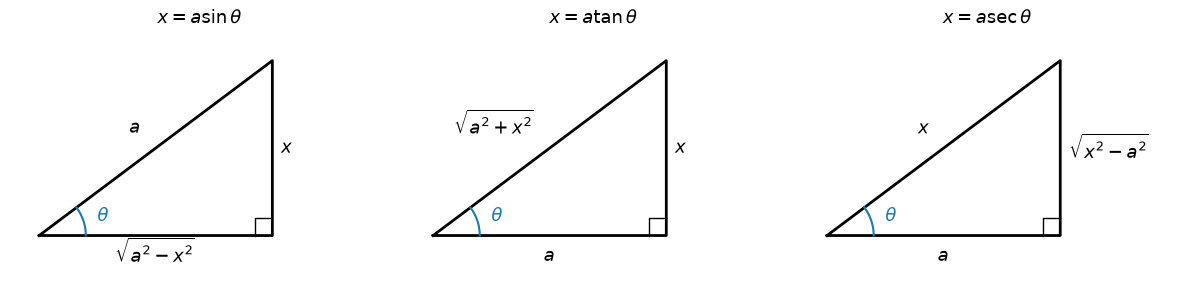
Let \(x = 3\sin\theta\) with \(-\pi/2 \le \theta \le \pi/2\). Then \(dx = 3\cos\theta\,d\theta\) and \(\sqrt{9 - x^2} = 3\cos\theta\): \[\int\frac{\sqrt{9 - x^2}}{x^2}\,dx = \int\frac{3\cos\theta}{9\sin^2\theta}\,3\cos\theta\,d\theta = \int\cot^2\theta\,d\theta = \int(\csc^2\theta - 1)\,d\theta = -\cot\theta - \theta + C.\]
Back to \(x\). From the triangle with opposite side \(x\) and hypotenuse \(3\), the adjacent side is \(\sqrt{9 - x^2}\), so \(\cot\theta = \dfrac{\sqrt{9 - x^2}}{x}\). Also \(\theta = \sin^{-1}(x/3)\): \[\int\frac{\sqrt{9 - x^2}}{x^2}\,dx = -\frac{\sqrt{9 - x^2}}{x} - \sin^{-1}\Big(\frac{x}{3}\Big) + C.\]
In SymPy we do the same steps: write the integrand in \(\theta\), integrate, and substitute \(\theta = \sin^{-1}(x/3)\). SymPy reads off the triangle for us, since it simplifies \(\cot(\sin^{-1}(x/3))\) automatically.
integrand_theta = (3 * sp.cos(theta)) / (9 * sp.sin(theta)**2) * 3 * sp.cos(theta)
display(Math(r"\int\frac{\sqrt{9-x^2}}{x^2}\,dx = \int " + sp.latex(sp.simplify(integrand_theta)) + r"\,d\theta"))
G = sp.integrate(sp.cot(theta)**2, theta)
display(Math(r"\int\cot^2\theta\,d\theta = " + sp.latex(G) + " + C"))
F = G.subs(theta, sp.asin(x / 3))
display(Math(r"\int\frac{\sqrt{9-x^2}}{x^2}\,dx = " + sp.latex(F) + " + C"))
check(F, sp.sqrt(9 - x**2) / x**2);
\(\displaystyle \int\frac{\sqrt{9-x^2}}{x^2}\,dx = \int \frac{1}{\tan^{2}{\left(\theta \right)}}\,d\theta\)
\(\displaystyle \int\cot^2\theta\,d\theta = - \theta - \frac{\cos{\left(\theta \right)}}{\sin{\left(\theta \right)}} + C\)
\(\displaystyle \int\frac{\sqrt{9-x^2}}{x^2}\,dx = - \operatorname{asin}{\left(\frac{x}{3} \right)} - \frac{3 \sqrt{1 - \frac{x^{2}}{9}}}{x} + C\)
d/dx(answer) == integrand: TrueFind the area enclosed by \(\dfrac{x^2}{a^2} + \dfrac{y^2}{b^2} = 1\).
Solving for \(y\), the upper half is \(y = \dfrac{b}{a}\sqrt{a^2 - x^2}\). By symmetry the area is four times the area in the first quadrant: \[A = \frac{4b}{a}\int_0^a\sqrt{a^2 - x^2}\,dx.\] Let \(x = a\sin\theta\). The limits change too: \(x = 0 \Rightarrow \theta = 0\), and \(x = a \Rightarrow \theta = \pi/2\). So we never have to go back to \(x\): \[A = \frac{4b}{a}\int_0^{\pi/2}a\cos\theta\cdot a\cos\theta\,d\theta = 4ab\int_0^{\pi/2}\cos^2\theta\,d\theta = 2ab\Big[\theta + \tfrac12\sin 2\theta\Big]_0^{\pi/2} = \pi ab.\] When \(a = b = r\) this is the area of a circle, \(\pi r^2\).
b = sp.Symbol("b", positive=True)
A_theta = 4 * a * b * sp.integrate(sp.cos(theta)**2, (theta, 0, sp.pi / 2))
A_direct = 4 * b / a * sp.integrate(sp.sqrt(a**2 - x**2), (x, 0, a))
display(Math(r"A = 4ab\int_0^{\pi/2}\cos^2\theta\,d\theta = " + sp.latex(A_theta)
             + r"\qquad\text{SymPy in } x\text{: } " + sp.latex(sp.simplify(A_direct))))

a_val, b_val = 3.0, 2.0
xs = np.linspace(0, a_val, 200_001)
print(f"a = 3, b = 2:  π·a·b = {np.pi * a_val * b_val:.6f},  NumPy trapezoid: {4 * np.trapezoid(b_val / a_val * np.sqrt(a_val**2 - xs**2), xs):.6f}")
\(\displaystyle A = 4ab\int_0^{\pi/2}\cos^2\theta\,d\theta = \pi a b\qquad\text{SymPy in } x\text{: } \pi a b\)
a = 3, b = 2: π·a·b = 18.849556, NumPy trapezoid: 18.849556t = np.linspace(0, 2 * np.pi, 400)
xs_q = np.linspace(0, a_val, 200)
fig, ax = plt.subplots(figsize=(6, 4))
ax.plot(a_val * np.cos(t), b_val * np.sin(t), "k", lw=2)
ax.fill_between(xs_q, 0, b_val / a_val * np.sqrt(a_val**2 - xs_q**2), alpha=0.3, color="C0",
label=r"$\int_0^a \frac{b}{a}\sqrt{a^2-x^2}\,dx = \frac{\pi ab}{4}$")
ax.axhline(0, color="gray", lw=0.8); ax.axvline(0, color="gray", lw=0.8)
ax.set_aspect("equal")
ax.set_title(r"Ellipse $\frac{x^2}{9}+\frac{y^2}{4}=1$: area $= 4\times$ shaded $= 6\pi$")
ax.legend(loc="lower left", fontsize=10)
plt.show()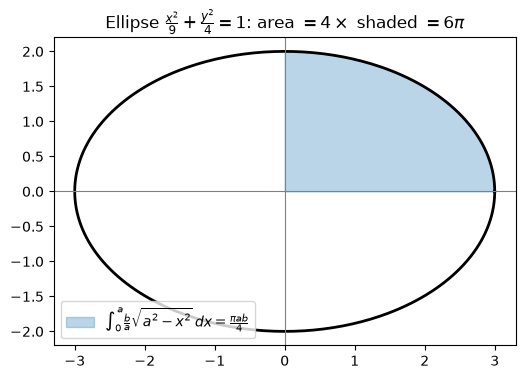
Let \(x = 2\tan\theta\) with \(-\pi/2 < \theta < \pi/2\). Then \(dx = 2\sec^2\theta\,d\theta\) and \(\sqrt{x^2 + 4} = 2\sec\theta\): \[\int\frac{dx}{x^2\sqrt{x^2 + 4}} = \int\frac{2\sec^2\theta}{4\tan^2\theta\cdot 2\sec\theta}\,d\theta = \frac14\int\frac{\sec\theta}{\tan^2\theta}\,d\theta.\] Write it in sines and cosines: \(\dfrac{\sec\theta}{\tan^2\theta} = \dfrac{1}{\cos\theta}\cdot\dfrac{\cos^2\theta}{\sin^2\theta} = \dfrac{\cos\theta}{\sin^2\theta}\). With \(u = \sin\theta\): \[\frac14\int\frac{\cos\theta}{\sin^2\theta}\,d\theta = \frac14\int\frac{du}{u^2} = -\frac{1}{4u} + C = -\frac{\csc\theta}{4} + C.\]
Back to \(x\). \(\tan\theta = x/2\): opposite \(x\), adjacent \(2\), hypotenuse \(\sqrt{x^2 + 4}\). So \(\csc\theta = \sqrt{x^2 + 4}/x\) and \[\int\frac{dx}{x^2\sqrt{x^2 + 4}} = -\frac{\sqrt{x^2 + 4}}{4x} + C.\]
integrand_theta = 2 * sp.sec(theta)**2 / (4 * sp.tan(theta)**2 * 2 * sp.sec(theta))
display(Math(r"\int\frac{dx}{x^2\sqrt{x^2+4}} = \int " + sp.latex(sp.simplify(integrand_theta)) + r"\,d\theta"))
G = sp.integrate(sp.cos(theta) / sp.sin(theta)**2, theta) / 4
F = G.subs(theta, sp.atan(x / 2))
display(Math(r"= " + sp.latex(G) + r" + C = " + sp.latex(sp.simplify(F)) + " + C"))
check(F, 1 / (x**2 * sp.sqrt(x**2 + 4)));
\(\displaystyle \int\frac{dx}{x^2\sqrt{x^2+4}} = \int \frac{\sec{\left(\theta \right)}}{4 \tan^{2}{\left(\theta \right)}}\,d\theta\)
\(\displaystyle = - \frac{1}{4 \sin{\left(\theta \right)}} + C = - \frac{\sqrt{x^{2} + 4}}{4 x} + C\)
d/dx(answer) == integrand: TrueWe could use \(x = 2\tan\theta\), but the numerator \(x\) is almost the derivative of \(x^2 + 4\). The ordinary substitution \(u = x^2 + 4\), \(du = 2x\,dx\) is much faster: \[\int\frac{x}{\sqrt{x^2 + 4}}\,dx = \frac12\int u^{-1/2}\,du = \sqrt{u} + C = \sqrt{x^2 + 4} + C.\] Always check for a simple substitution first. Trig substitution is for when the root doesn’t come with its inner derivative.
F = sp.sqrt(x**2 + 4)
display(Math(r"\int\frac{x}{\sqrt{x^2+4}}\,dx = " + sp.latex(F) + " + C"))
check(F, x / sp.sqrt(x**2 + 4))

# The trig-substitution route gives the same answer, just with more work
G = sp.integrate(sp.tan(theta) * sp.sec(theta) * 2, theta)     # 2 tanθ · 2sec²θ / (2secθ)
display(Math(r"x = 2\tan\theta:\quad \int 2\tan\theta\sec\theta\,d\theta = " + sp.latex(G)
             + r" = " + sp.latex(sp.simplify(G.subs(theta, sp.atan(x / 2)))) + " + C"));
\(\displaystyle \int\frac{x}{\sqrt{x^2+4}}\,dx = \sqrt{x^{2} + 4} + C\)
d/dx(answer) == integrand: True\(\displaystyle x = 2\tan\theta:\quad \int 2\tan\theta\sec\theta\,d\theta = \frac{2}{\cos{\left(\theta \right)}} = \sqrt{x^{2} + 4} + C\)
Let \(x = a\sec\theta\) with \(0 < \theta < \pi/2\) or \(\pi < \theta < 3\pi/2\). Then \(dx = a\sec\theta\tan\theta\,d\theta\) and \(\sqrt{x^2 - a^2} = a\tan\theta\): \[\int\frac{dx}{\sqrt{x^2 - a^2}} = \int\frac{a\sec\theta\tan\theta}{a\tan\theta}\,d\theta = \int\sec\theta\,d\theta = \ln|\sec\theta + \tan\theta| + C.\] (The integral of \(\sec\theta\) is from §7.2.)
Back to \(x\). \(\sec\theta = x/a\): hypotenuse \(x\), adjacent \(a\), opposite \(\sqrt{x^2 - a^2}\). So \(\tan\theta = \sqrt{x^2 - a^2}/a\) and \[\int\frac{dx}{\sqrt{x^2 - a^2}} = \ln\left|\frac{x}{a} + \frac{\sqrt{x^2 - a^2}}{a}\right| + C = \ln\left|x + \sqrt{x^2 - a^2}\right| + C_1,\] where \(C_1 = C - \ln a\). The constant \(\ln a\) is absorbed into the arbitrary constant.
G = sp.log(sp.sec(theta) + sp.tan(theta))
F = sp.log(x + sp.sqrt(x**2 - a**2))
display(Math(r"\int\sec\theta\,d\theta = " + sp.latex(G) + r"\quad\Longrightarrow\quad \int\frac{dx}{\sqrt{x^2-a^2}} = " + sp.latex(F) + " + C"))
check(F, 1 / sp.sqrt(x**2 - a**2), pts=())       # symbolic check, for any a > 0

# Numerical check for a = 2 on [3, 5]
xs = np.linspace(3, 5, 100_001)
exact = np.log(5 + np.sqrt(21)) - np.log(3 + np.sqrt(5))
print(f"a = 2:  ∫_3^5 dx/√(x²-4) = {exact:.8f},  NumPy trapezoid: {np.trapezoid(1 / np.sqrt(xs**2 - 4), xs):.8f}")
\(\displaystyle \int\sec\theta\,d\theta = \log{\left(\tan{\left(\theta \right)} + \sec{\left(\theta \right)} \right)}\quad\Longrightarrow\quad \int\frac{dx}{\sqrt{x^2-a^2}} = \log{\left(x + \sqrt{- a^{2} + x^{2}} \right)} + C\)
d/dx(answer) == integrand: True
a = 2: ∫_3^5 dx/√(x²-4) = 0.60437559, NumPy trapezoid: 0.60437559The fractional power is still a square root: \((4x^2 + 9)^{3/2} = \big(\sqrt{4x^2 + 9}\big)^3\). Here \(4x^2 + 9 = (2x)^2 + 3^2\), so let \(2x = 3\tan\theta\), that is \(x = \tfrac32\tan\theta\). Then \[dx = \tfrac32\sec^2\theta\,d\theta,\qquad \sqrt{4x^2 + 9} = \sqrt{9\tan^2\theta + 9} = 3\sec\theta.\] New limits: \(x = 0 \Rightarrow \tan\theta = 0 \Rightarrow \theta = 0\), and \(x = \tfrac{3\sqrt3}{2} \Rightarrow \tan\theta = \sqrt3 \Rightarrow \theta = \tfrac{\pi}{3}\). \[\int_0^{3\sqrt3/2}\frac{x^3}{(4x^2 + 9)^{3/2}}\,dx = \int_0^{\pi/3}\frac{\tfrac{27}{8}\tan^3\theta}{27\sec^3\theta}\cdot\tfrac32\sec^2\theta\,d\theta = \frac{3}{16}\int_0^{\pi/3}\frac{\tan^3\theta}{\sec\theta}\,d\theta = \frac{3}{16}\int_0^{\pi/3}\frac{\sin^3\theta}{\cos^2\theta}\,d\theta.\] This is a §7.2 integral with an odd power of sine. Save one \(\sin\theta\) and let \(u = \cos\theta\), \(du = -\sin\theta\,d\theta\). The limits become \(u = 1\) and \(u = \tfrac12\): \[\frac{3}{16}\int_0^{\pi/3}\frac{1 - \cos^2\theta}{\cos^2\theta}\sin\theta\,d\theta = \frac{3}{16}\int_{1/2}^{1}\frac{1 - u^2}{u^2}\,du = \frac{3}{16}\Big[-\frac1u - u\Big]_{1/2}^{1} = \frac{3}{16}\Big[(-2) - \big(-\tfrac52\big)\Big] = \frac{3}{32}.\]
step_theta = sp.Rational(3, 16) * sp.integrate(sp.sin(theta)**3 / sp.cos(theta)**2, (theta, 0, sp.pi / 3))
step_u = sp.Rational(3, 16) * sp.integrate((1 - u**2) / u**2, (u, sp.Rational(1, 2), 1))
direct = sp.integrate(x**3 / (4 * x**2 + 9)**sp.Rational(3, 2), (x, 0, 3 * sp.sqrt(3) / 2))
display(Math(r"\text{in }\theta: " + sp.latex(sp.simplify(step_theta)) + r",\quad \text{in } u: " + sp.latex(step_u)
             + r",\quad \text{SymPy in } x: " + sp.latex(sp.simplify(direct))))

xs = np.linspace(0, 3 * np.sqrt(3) / 2, 100_001)
print(f"3/32 = {3 / 32:.10f},  NumPy trapezoid: {np.trapezoid(xs**3 / (4 * xs**2 + 9)**1.5, xs):.10f}")
\(\displaystyle \text{in }\theta: \frac{3}{32},\quad \text{in } u: \frac{3}{32},\quad \text{SymPy in } x: \frac{3}{32}\)
3/32 = 0.0937500000, NumPy trapezoid: 0.0937500000When the expression under the root is a general quadratic \(ax^2 + bx + c\), complete the square first. It then becomes one of the three forms.
Complete the square: \[3 - 2x - x^2 = 3 - (x^2 + 2x) = 3 + 1 - (x^2 + 2x + 1) = 4 - (x + 1)^2.\] Let \(u = x + 1\), so \(x = u - 1\) and \(du = dx\): \[\int\frac{x}{\sqrt{3 - 2x - x^2}}\,dx = \int\frac{u - 1}{\sqrt{4 - u^2}}\,du.\] This is the \(\sqrt{a^2 - u^2}\) form with \(a = 2\). Let \(u = 2\sin\theta\), \(du = 2\cos\theta\,d\theta\), \(\sqrt{4 - u^2} = 2\cos\theta\): \[\int\frac{2\sin\theta - 1}{2\cos\theta}\,2\cos\theta\,d\theta = \int(2\sin\theta - 1)\,d\theta = -2\cos\theta - \theta + C.\] Back to \(x\). \(\sin\theta = u/2\), so \(\cos\theta = \sqrt{4 - u^2}/2\) and \(\theta = \sin^{-1}(u/2)\): \[\int\frac{x}{\sqrt{3 - 2x - x^2}}\,dx = -\sqrt{4 - u^2} - \sin^{-1}\Big(\frac u2\Big) + C = -\sqrt{3 - 2x - x^2} - \sin^{-1}\Big(\frac{x + 1}{2}\Big) + C.\]
q = 3 - 2 * x - x**2
display(Math(sp.latex(q) + " = " + sp.latex(4 - (x + 1)**2) + r"\quad\text{: }" + str(sp.expand(q - (4 - (x + 1)**2)) == 0)))

G = sp.integrate(2 * sp.sin(theta) - 1, theta)
F = G.subs(theta, sp.asin(u / 2)).subs(u, x + 1)
display(Math(r"\int(2\sin\theta - 1)\,d\theta = " + sp.latex(G) + r"\quad\Longrightarrow\quad \int\frac{x}{\sqrt{3-2x-x^2}}\,dx = " + sp.latex(F) + " + C"))
check(F, x / sp.sqrt(q), pts=(-2.5, -1.2, 0.0, 0.4, 0.8));     # 3 - 2x - x² > 0 for -3 < x < 1
\(\displaystyle - x^{2} - 2 x + 3 = 4 - \left(x + 1\right)^{2}\quad\text{: }True\)
\(\displaystyle \int(2\sin\theta - 1)\,d\theta = - \theta - 2 \cos{\left(\theta \right)}\quad\Longrightarrow\quad \int\frac{x}{\sqrt{3-2x-x^2}}\,dx = - 2 \sqrt{1 - \frac{\left(x + 1\right)^{2}}{4}} - \operatorname{asin}{\left(\frac{x}{2} + \frac{1}{2} \right)} + C\)
d/dx(answer) == integrand: TrueHere is mistake 6 checked: with \(x = \tfrac32\sin\theta\) the root simplifies, with \(x = 3\sin\theta\) it doesn’t.
for sub in [sp.Rational(3, 2) * sp.sin(theta), 3 * sp.sin(theta)]:
    root = sp.trigsimp(sp.sqrt(9 - 4 * sub**2))
    display(Math(rf"x = {sp.latex(sub)}:\quad \sqrt{{9-4x^2}} = {sp.latex(root)}"))
\(\displaystyle x = \frac{3 \sin{\left(\theta \right)}}{2}:\quad \sqrt{9-4x^2} = 3 \sqrt{\cos^{2}{\left(\theta \right)}}\)
\(\displaystyle x = 3 \sin{\left(\theta \right)}:\quad \sqrt{9-4x^2} = \sqrt{9 - 36 \sin^{2}{\left(\theta \right)}}\)
Try each by hand first, then compare with the answers below. Each answer is checked by differentiating it at points where the integrand is defined. If yours looks different, run check on it: it may differ only by a constant.
# (integrand, answer, sample points inside the domain)
problems = [
    (x**2 / sp.sqrt(9 - x**2), sp.Rational(9, 2) * sp.asin(x / 3) - x * sp.sqrt(9 - x**2) / 2, (0.5, 1.5, -2.0)),
    (1 / (x**2 + 1)**sp.Rational(3, 2), x / sp.sqrt(x**2 + 1), (0.3, 1.0, -2.0)),
    (sp.sqrt(x**2 - 4) / x, sp.sqrt(x**2 - 4) - 2 * sp.asec(x / 2), (2.5, 3.0, 5.0)),
    (1 / (x**2 * sp.sqrt(16 - x**2)), -sp.sqrt(16 - x**2) / (16 * x), (0.5, 3.0, -1.0)),
    (1 / sp.sqrt(x**2 + 2 * x + 5), sp.log(x + 1 + sp.sqrt(x**2 + 2 * x + 5)), (-3.0, 0.0, 2.0)),
]
for p, F, pts in problems:
    display(Math(r"\int " + sp.latex(p) + r"\,dx = " + sp.latex(F) + " + C"))
    check(F, p, pts=pts)

definite = [
    (sp.sqrt(1 + x**2), 0, 1, lambda t: np.sqrt(1 + t**2)),
    (sp.sqrt(4 - 9 * x**2), 0, sp.Rational(2, 3), lambda t: np.sqrt(np.maximum(4 - 9 * t**2, 0))),
]
for p, lo, hi, fn in definite:
    val = sp.integrate(p, (x, lo, hi))
    xs = np.linspace(float(lo), float(hi), 200_001)
    display(Math(rf"\int_{{{sp.latex(lo)}}}^{{{sp.latex(hi)}}} " + sp.latex(p) + r"\,dx = "
                 + sp.latex(sp.simplify(val)) + rf" \approx {float(val):.6f}"))
    print(f"NumPy check: {np.trapezoid(fn(xs), xs):.6f}")
\(\displaystyle \int \frac{x^{2}}{\sqrt{9 - x^{2}}}\,dx = - \frac{x \sqrt{9 - x^{2}}}{2} + \frac{9 \operatorname{asin}{\left(\frac{x}{3} \right)}}{2} + C\)
d/dx(answer) == integrand: True\(\displaystyle \int \frac{1}{\left(x^{2} + 1\right)^{\frac{3}{2}}}\,dx = \frac{x}{\sqrt{x^{2} + 1}} + C\)
d/dx(answer) == integrand: True\(\displaystyle \int \frac{\sqrt{x^{2} - 4}}{x}\,dx = \sqrt{x^{2} - 4} - 2 \operatorname{asec}{\left(\frac{x}{2} \right)} + C\)
d/dx(answer) == integrand: True\(\displaystyle \int \frac{1}{x^{2} \sqrt{16 - x^{2}}}\,dx = - \frac{\sqrt{16 - x^{2}}}{16 x} + C\)
d/dx(answer) == integrand: True\(\displaystyle \int \frac{1}{\sqrt{x^{2} + 2 x + 5}}\,dx = \log{\left(x + \sqrt{x^{2} + 2 x + 5} + 1 \right)} + C\)
d/dx(answer) == integrand: True\(\displaystyle \int_{0}^{1} \sqrt{x^{2} + 1}\,dx = \frac{\log{\left(1 + \sqrt{2} \right)}}{2} + \frac{\sqrt{2}}{2} \approx 1.147794\)
NumPy check: 1.147794\(\displaystyle \int_{0}^{\frac{2}{3}} \sqrt{4 - 9 x^{2}}\,dx = \frac{\pi}{3} \approx 1.047198\)
NumPy check: 1.047198| Expression | Substitution | \(dx\) | Root becomes | Triangle |
|---|---|---|---|---|
| \(\sqrt{a^2 - x^2}\) | \(x = a\sin\theta\) | \(a\cos\theta\,d\theta\) | \(a\cos\theta\) | opp \(x\), hyp \(a\), adj \(\sqrt{a^2 - x^2}\) |
| \(\sqrt{a^2 + x^2}\) | \(x = a\tan\theta\) | \(a\sec^2\theta\,d\theta\) | \(a\sec\theta\) | opp \(x\), adj \(a\), hyp \(\sqrt{a^2 + x^2}\) |
| \(\sqrt{x^2 - a^2}\) | \(x = a\sec\theta\) | \(a\sec\theta\tan\theta\,d\theta\) | \(a\tan\theta\) | hyp \(x\), adj \(a\), opp \(\sqrt{x^2 - a^2}\) |
| \(\sqrt{ax^2 + bx + c}\) | complete the square first |
The steps: 1. Check for a simple \(u\)-substitution first. 2. Choose the substitution from the table (complete the square if needed). 3. Replace \(x\), \(dx\) and the root. The integral becomes a trigonometric integral (§7.2). 4. Integrate in \(\theta\). 5. Go back to \(x\) with the triangle, or change the limits for a definite integral.
\[\int\frac{dx}{\sqrt{x^2 - a^2}} = \ln\left|x + \sqrt{x^2 - a^2}\right| + C,\qquad \int\sqrt{a^2 - x^2}\,dx\Big|_0^a = \frac{\pi a^2}{4}\]